


What is a home battery?
Back
A home battery, in a nutshell, is a large battery connected to the meter box. It stores power that you can later use throughout the house, reducing your dependence on the grid. This reduces feed-in costs and avoids problems once the balancing scheme expires.
In this blog, you will discover in which situations a home battery can come in handy. We walk through the main applications:
- Solar panel owners
- Peak-shaving (increasing peak power in the home)
- Trading on the energy market
- Off-grid systems and emergency power
- Caravans and other recreational vehicles
A home battery is more technically complex than we can fully cover here. Are you considering a purchase? If so, always contact an adviser to see what is best for your situation.
A home battery is not a one-size-fits-all solution. So get free advice from our experts to determine what best suits your situation.
Important to know: a home battery uses a different type of battery than phones or electric cars. They are a bit heavier and therefore less suitable for devices where weight is important. The advantage is that this type of battery is much safer: the risk of fire is practically negligible compared to batteries in electric cars or phones.
In the rest of the blog, we will discover all the interesting situations for a home battery.
Solar panel owners
An average household with solar panels uses only 20-30% of its own generated power directly. In the past, during the net-metering scheme without feed-in charges, this was not a problem: the power grid worked like a free battery. However, that proved unsustainable, as more and more people participated and the grid became overloaded.
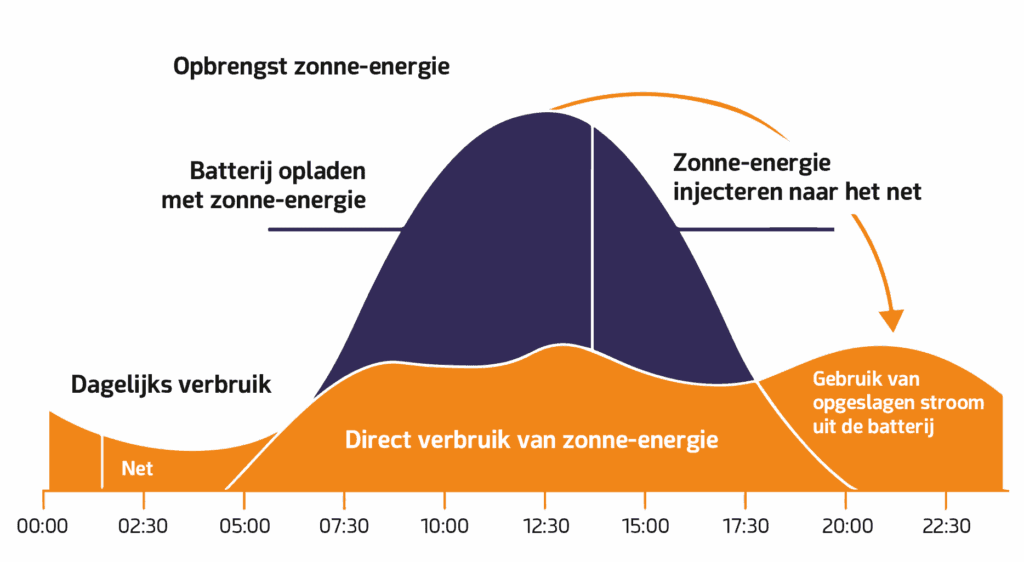
Suppliers therefore introduced feed-in fees at the end of 2023. Since then, you pay for every kWh you feed back, even if you later balance it away. From 1 January 2027, the balancing scheme will end completely and you will only receive a limited feed-in compensation.
Whereas it used to be smart to install as many solar panels as possible and maximise production, it is now wiser to become as independent from the grid as possible and use your solar power directly yourself. The new goal for households looking to become more sustainable is therefore to get their energy bills as close to zero as possible.
You can reduce that bill by reducing your own consumption (e.g. with better insulation) or by storing excess power. The most versatile way to do this is with a home battery. Solar power that you generate during the day but do not consume immediately is stored so that you can use it later.
If you have a dynamic energy contract (where the power price changes every hour), the home battery uses a smarter algorithm than just storing excess solar power. The system compares expected power prices with your predicted consumption, helping you save even more.
Peak-shaving
Every house has a mains connection with a maximum allowed current. If this limit is exceeded, the main fuse trips.
When you start renovating and your power consumption increases, for example because you cook on induction while you want to charge your electric car, your current connection may no longer be sufficient. The most logical solution is then to upgrade the connection so that you can draw more power from the grid. In practice, however, this is costly, can take months and provides no other additional benefits.
A home battery can solve this problem. In peak-shaving mode, the battery jumps in as soon as the consumption ceiling is almost reached. So you can still use induction and charge your car at the same time, even if your grid connection is actually too small.

Trading on the energy market
With a dynamic energy contract, the lowest purchasing price of power is lower than the highest selling price. With a home battery, you can take advantage of this by buying power cheaply and later selling it more expensively, or using it yourself.
This can be cost-effective, although in practice the payback period is usually longer than for solar panels. For people who do not yet have solar panels or a home battery, it is therefore often wiser to look at a combination of both, tailored to their own situation. Trading on the energy market with only a home battery is really only interesting when you cannot install solar panels, for example if you live in a flat.
Off-grid
The world sometimes seems less and less peaceful. It is therefore not strange to worry about what the future may bring. The Dutch power grid is reliable, but suppose the power goes out - what does that mean for you?

Maybe you have medical equipment in your home, run sensitive servers or just want to be prepared rather than sorry. Here, too, a home battery can help.
Many models feature a backup power socket. This means that when the power fails, the battery always keeps a socket available.
Note: are you interested in a system that is not connected to the electricity grid, e.g. for a holiday home in the woods? Then check carefully that any equipment you buy is suitable for this. This is because most inverters and home batteries will not work without a grid connection.
Do you really want to be sure of emergency power? These days, there are special meter boxes that allow the home battery to power your entire house in the event of an outage. You can't just do that: a system must be in place that completely disconnects your home from the grid to prevent feedbacks.
Caravans
Finally, there is the situation where you are in a caravan or other recreational vehicle without enough power for all your needs. There too, a home battery can be a solution.
In this case, it is advisable to use a mobile home battery. These are designed to be moved regularly, are easy to grip and more resistant to impacts.
I am interested, now what?
Many factors come into play when choosing a home battery, including the storage capacity needed, the maximum discharge current and much more. In a subsequent blog, we will explore in more detail the choices you can make when buying a home battery.
Can't wait for the next blog? Then contact one of our advisers directly and we will look at the most suitable solution for your situation.